

In this episode of The Quilt Scouts Podcast, Megan interviews Ann of Crafty Moose Quilts about quilting with chronic illness and injury—adaptations, rest, grief, and sustainable creativity.
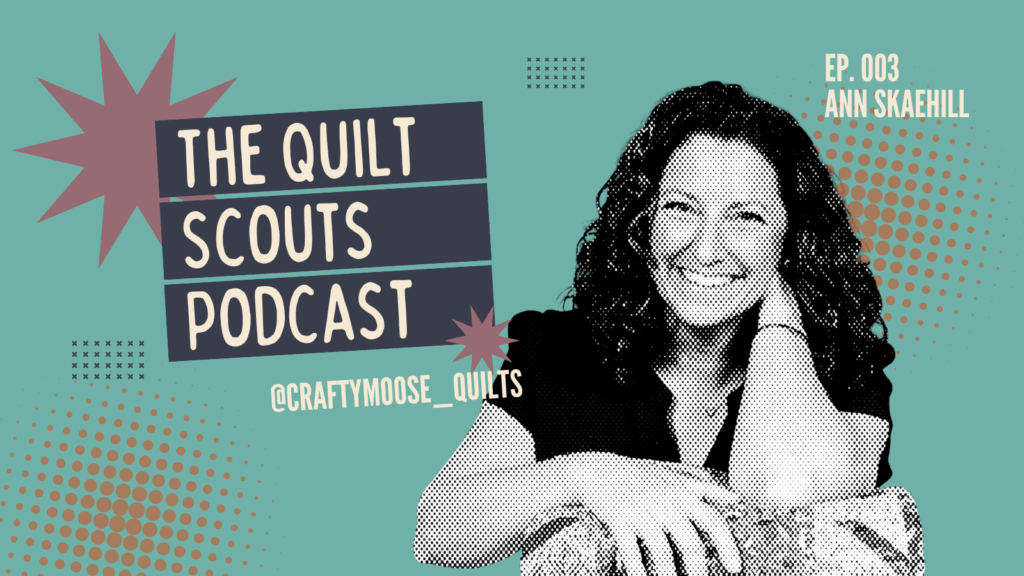
Quilting Can Be a Mental Escape… But Your Body Still Needs Care
Quilting can be the best kind of escape: you get to pick the colors, make the rules, and disappear into a project for a while. But as my friend Ann (Crafty Moose Quilts) puts it so perfectly in this episode: quilting might be a mental escape, but it isn’t always the physical escape your body needs.
This episode is part of our Self-Care Quilter month, and we go way beyond the fluffy version of “self-care.” We’re talking about the real stuff: chronic illness, injuries, grief, overstimulation, asking for help, adapting your sewing practice, and what it looks like to keep a creative life going through changing seasons.
If you’ve ever felt sidelined, frustrated, or like your body is betraying you… please know you’re not alone. This conversation is for you.
🎧 Listen to Episode 3
What You’ll Hear in This Episode
This conversation is honest, comforting, and packed with practical takeaways. Here are the big themes we cover:
1) Quilting as Escape (and When It Stops Helping)
Ann shares how quilting became a lifeline when health issues changed the life she thought she’d live. Quilting gave her control when everything else felt uncertain — but she also talks about the moment you realize you can’t use quilting as your only coping tool forever.
2) Adaptation Isn’t Just Physical — It’s Emotional
We talk about grief (because yep, it shows up here), and how adapting often requires mental gymnastics first. Ann shares a story that made me laugh and wince: learning to use her machine pedal with her left foot after recurring tendon issues in her right foot.
3) Systems That Support the Brain (and Protect the Body)
Ann’s organization systems are legendary for a reason. She talks about:
- keeping tools within safe reach
- using whiteboards to track customer quilts + pattern ideas
- creating a one-bin-per-project system to reduce chaos and overwhelm
- outsourcing parts of her process to protect her body and expand capacity
This section is basically a permission slip to build systems that make your creativity easier.
4) When Rest Isn’t Optional
This is one of the most powerful parts of the episode: what it’s like when adaptation isn’t possible, and you have to stop. Ann shares what helped her cope (including small creative substitutions like coloring, handwork, and finding soothing routines when her brain needed quiet).
5) Self-Care for Quilters = More Than Quilting
Ann gives the most practical self-care reminder ever: don’t just eat the sewing-room candy and call it a day. (We love an M&M moment, but still.) She talks about stretching, hydration, movement, and recognizing when you’ve pushed too hard.
6) Scout Wisdom You’ll Want to Replay
Ann’s closing advice is… whew. She speaks directly to the quilter who’s frustrated, grieving, or limited right now — and offers a path that’s compassionate and grounded:
- process the grief
- don’t “set up camp” there
- do one small thing today that brings you joy
- the story you tell yourself has more power than you think
Resources & Links Mentioned
Here’s everything referenced in the episode (so you don’t have to hunt around):
- Ann’s website: craftymoosequilts.com
- Ann on Instagram: @craftymoose_quilts
- Quilt Scouts: quiltscouts.com
- Mentioned by Ann: T-Shirt Tiles patterns
- Mentioned: Happy Camper fabric collection by Maureen Cracknell
- Mentioned: Stargrove pattern (featured in the AGF Happy Camper lookbook)
- Quote referenced: “Whether you think you can or you think you can’t, you’re right.” — Henry Ford
Cozy Earth Discount (Mentioned in This Episode)
Since we talk about rest and recovery so much in this conversation, I want to share the product mentioned in the mid-episode break.
I’ve been using Cozy Earth sheets for a while now, and they are genuinely the softest, most breathable sheets I’ve ever slept on. They’re temperature-regulating, incredibly gentle, and honestly feel like a small but meaningful upgrade when your body needs extra care.
✨ You can get 20% off site-wide using this link:
👉 https://cozyearth.com/SFMHKJVH
No pressure — just something I truly use and love, especially during seasons when rest matters more than hustle.
A Low-Pressure Next Step (If You Want More Support)
If you’re craving a little more structure, encouragement, and “you can do this” energy while you keep quilting in real life… that’s exactly what Quilt Scouts is here for.
You can explore Quilt Scouts here: quiltscouts.com
And either way — I’m really glad you’re here.
Episode 3 Transcript
Click to read the full transcript from Episode 3 of The Quilt Scouts Podcast for accessibility and reference.
Ann (00:00)
I had so many projects that were stacked one right on top of the next, on top of next, on top of the I was not good about self care. And I paid for
So I think it’s good to remember that while quilting can be a mental escape, it’s probably not also the physical escape that you need.
Megan (00:20)
Welcome to the Quilt Scouts podcast. I’m Megan, your quilt scout leader and fellow adventurous quilter. This is a cozy campfire chat for quilters who crave creativity, community, and a gentle nudge to try something new. Each week we’ll talk about quilting, and the small adventures that help us grow more confident one stitch at a time. I’m so glad you’re here. Let’s get into it.
Megan (00:48)
Before we get started, I want to give you a little context for today’s conversation. This episode is part of our Self-Care Quilter Month, but I want to be really clear about what that means. This is not a surface level conversation. It’s not about productivity hacks or pushing through at all costs.
Today, I’m talking with my friend Ann from Crafty Moose Quilts about what it actually looks like to make quilting sustainable when your body, your health or your energy doesn’t always cooperate. We talk honestly about chronic illness, injury, grief, adaptation and the courage it takes to keep creating. Sometimes by changing how you quilt and sometimes by stepping away entirely. If you ever felt frustrated, sidelined or betrayed by your body,
This conversation is for you.
Megan (01:34)
Hi Ann! welcome to the Quilt Scouts podcast. How are you doing?
Ann (01:39)
Thank you so much for asking me to be a part of this I’m super honored and blown away that you would ask me to be your very first guest on the quilt Scouts podcast. So thank you for that
Megan (01:48)
I know. I’m so excited.
Thank you.
So to start us off for listeners who might not know you yet, can you tell us a little about yourself and your relationship with quilting?
Ann (02:00)
Yeah, so I was the outdoor kid growing up. I hated everything that had to do with fabric and fabric shops and pins and patterns and sewing machines and threads and I hated all of it. I just wanted to go play outside. My mom, my grandmother and both of my older sisters loved it. They loved picking out fabrics and mom used to make a bunch of our clothes.
Megan (02:14)
You
Ann (02:25)
Gosh, even, my sister and I were just reminiscing about this the other day. She even made multiple bridesmaid dresses. She’s made flower girl dresses. She’s made all kinds of things. So for me, my relationship with quilting really didn’t even begin until I started to have health issues. And once I was diagnosed with several things and I was just kind of sidelined from the life I thought I was going to live,
My mom had brought over my grandmother’s sewing machine after she had passed away and it was sitting in my crafting closet. I used to be real heavy into scrapbooking. In fact, that was a business that I had for a long time. I made custom scrapbooks for other people and I saw that sewing machine sitting in there and I just kind of felt defiant that day and I thought, you know what? I could make a quilt like granny used to. It can’t be that hard.
Megan (03:17)
We all start off, I think, with that false sense of confidence in our first quilt.
Ann (03:17)
It turns out it was.
Exactly, So, yeah, my first quilt, I still have it. I love it. It’s made entirely out of fabrics that were my granny’s. I have no idea if they’re quilting cottons. I feel pretty confident some of them are not. But it was terrible. It was not good. My mom, I ended up having to wave the white flag and I was like, can you come help me with this quilt? And she was like, I’m sorry. Did you just say?
Megan (03:23)
haha
You
Ann (03:45)
Quilt, are you talking about sewing? And I said, no, don’t get too excited. I’m trying to be defiant here and you’re not helping. ⁓
She walked me through like a quarter inch seam and why pressing is important and how to properly use a rotary cutter and it actually matters which direction your bobbin goes in the sewing machine and you know all of those things that I just kind of glossed over because I thought it couldn’t be that hard to cut squares and sew them together.
Megan (04:12)
Yes,
yeah, it’s, I feel like that’s a similar story for all first quilts. It’s, they’re always start off rough, but they’re always like the most loved too. Like you said, I still have my first quilt and it’s one of my favorites. I think, I don’t know what it is about it, but it is one of my favorite quilts to snuggle up with, even though it’s a little rough looking. So your grandma and your mom are quilters. And garment sewers, it sounds like.
Ann (04:28)
Yeah. don’t know. I feel.
Well,
My mom was a quilter mostly only after her mom passed away. So my mom is amazing. She’s just a hero of all sorts. So Granny used to use unused pizza boxes, and that’s what she used to keep all of her sewing projects organized. So when she passed away, my mom and her siblings found in Granny’s closet, it was like this huge stack of pizza boxes.
Every pizza box had someone’s name on it. And my mom went through and she finished every single quilt and gifted it to the person that it was intended for.
Megan (05:10)
⁓ that is so special. Your mom is an MVP. Wow. I love that. That’s really cool. And I know your mom did the sweater weather sampler too. She joined us this last fall. Well, think the last, I think she’s done everyone, hasn’t she? But I know she definitely did this last one.
Ann (05:16)
Yeah, she really is. Yeah.
Yep.
She did. She definitely did this last one. She actually, all she has left is autumn outpost. She was like…
Megan (05:35)
Sorry Judy!
Ann (05:36)
It’s okay. I
told her I’ll come over and I’ll help her. And I said, you know what? Mine was not great either, but you can’t even tell. You know, I had to add a couple extra pieces of fabric and nobody knows that and it still looks fantastic. So we’re gonna, we’re gonna knock it out together. But I think, I think she has participated all three years, but this is the furthest she’s gotten with getting eight blocks done. But she also
Megan (05:48)
Mm-hmm.
That’s good.
Yeah, eight out of the nine blocks.
Ann (06:00)
She probably has more health issues than I. Well.
I don’t know, we might be tied. Yeah, but this past year has been really tough for her. So it’s been really cool to watch her figure out how and when to sew and when it makes sense and when it doesn’t. And every time she’d finish another block, she’d send me a text and I was like, yay mom, you did another one.
Megan (06:04)
Are you guys tied?
Mm-hmm.
It’s like exactly what we’re talking about today. Doing what you can in the moment and not putting too much pressure on yourself to finish it. Just do what you can, but enjoy it along the way. feel like sometimes we forget that it’s supposed to be fun. Not, you know, we’re not supposed to challenge ourselves and beat ourselves up for the stuff we can’t do.
Ann (06:32)
Yes, exactly.
Megan (06:37)
Okay, so I would love to talk about how your creative life and your health have intersected. I know we’ve talked a lot about this personally, but I would love for you to share your story here as well. So can you share a bit about your experience with chronic illness and physical injuries and how that shaped the way that you quilt?
Ann (06:54)
Yeah, so I wasn’t quite bedridden when I was first diagnosed with multiple autoimmune issues and it was just a weird time. Back then with autoimmune, it felt like all they did was throw medications at things. I feel like medicine, but also functional medicine has come so far.
since when I was first diagnosed, but back in the day it was like, well that medication didn’t work, try this one. that didn’t work, try this one. And every medication comes with a whole suitcase full of side effects. So it was like, this one thing started to feel better, but now I have these six other things that are making my life miserable. And that whole first year was just, I just.
to throw a stranger things reference out there, because I feel like it’s applicable right now, but I felt like I was in the upside down. I just couldn’t get out. I just couldn’t find my way out. And when I started quilting, it kind of became an escape from my own reality. It gave me a place where I felt like I had some control, because this other part of my life, I just really didn’t have control. And I was very lost, I was very confused.
Megan (07:53)
Mmm.
Ann (08:13)
I didn’t know how to process it or handle it and I ended up, mean like even some of my closest friendships ended up really damaged because I didn’t know how to articulate what I was thinking and feeling and I just kind of disappeared into the background. And it wasn’t intentional, there wasn’t anything about any of those friendships that I was like, can’t wait to get away from you. It wasn’t that at all, I was just, I was in self-preservation mode and it-
Megan (08:37)
Mm-hmm.
Yeah.
Ann (08:42)
it wasn’t pretty. So quilting really became that place where I was like, I get to pick the colors, I get to pick the layout. And unbeknownst to me, I actually even started designing quilts. I really didn’t know that I was doing that, but I started doing that because when I would read quilt patterns, I would get so frustrated. Sometimes they would look so pretty on the cover and you’d buy it and you’d get home and you’d open it up. And it was like these black and white papers that were stapled at the corner.
with no pictures, no diagrams, like misspelled words. And I was like, I, this is not helpful to me at all. So, exactly. So quilting is still, it’s still kind of a mental escape for me. And I know that we’ll get to this later in the interview, but it can’t always be the place that you go to. There are times where,
Megan (09:18)
like this is just stressing me out more.
Ann (09:36)
You have to stop and you have to sit down or you have to lie down or you have to go do the therapies or the appointments or the my gosh all the different things. And that’s hard because it forces you to face your reality. But it really is. I mean I could spend I could spend 18 hours a day in this room in my office creating and crafting and I will completely lose track of time. I will forget to eat.
I’ll be like, why do I have to go to the bathroom so bad? And I’m like, oh, it’s been like five hours. I should probably hydrate too while I’m out there.
Megan (10:04)
You
Ann (10:09)
So, yeah, exactly. So it really is, it always has been my happy place, my escape place.
Megan (10:09)
Come up for air.
Okay, so was there a moment when you realized you couldn’t quilt the same way that you used to and you had to kind of pivot?
Ann (10:26)
I’ve had a lot of those moments. We don’t really have an answer to all of my different health issues and I don’t know that I ever will have answers. I went through a period of time where I was just chasing the why. Why this? Why that? Why this? Why that? And that was exhausting. I really thought that I was gonna get to bottom, get to the middle of the tootsie pop, but I never did.
So I eventually gave up on that. Not in a defeated way, but in a…
If I want to have peace in my life, I just have to accept that I’m going to have lots of speed bumps.
Megan (10:58)
I imagine it was kind of like going through those steps of like grief, right? Like you’re kind of mourning that change and then accepting it. Is that? Yeah.
Ann (11:02)
of
Absolutely. ⁓
And grief, it’s interesting that you bring that word up. That is like a recurring theme. Anytime I go to counseling, you know, I’ll say all of these things and I don’t know why I’m feeling this and I don’t know why. And almost every time the therapist is like, this is grief. And I’m like, of course it is. I should have just started there. Of course it is. It is really hard to come to terms with the fact that you can’t do something.
the same way that you’ve always been able to do it. And I’m still in my 40s, and I’ve told my husband this since I was in my 30s, I physically feel like I’m 70. And I’m not trying to put down anybody who’s in their 70s. They may feel like they’re in their 30s, and more power to them. But I have always felt like my body is much older than my actual age. And I think…
because I have felt that way for so long, it makes it easier to adapt, but the mental gymnastics are always really challenging for me. I had an issue, I have a recurring issue with the tendons in my right foot. Again, we don’t know why it happens, but it just happens. And sometimes I go through a phase where it’s very difficult to walk. The tendons just don’t wanna stretch.
And it’s my right foot, which is the foot I use for my sewing pedal. And I think most people do because that’s typically how we drive is with our right foot. So he was asking me what kind of repetitive things are you doing? Are you, you know, are you going for really long walks every day? Are you using a stair stepper? Like, are you, what are you doing? And I was like, I don’t know. I just work. Well, what do you do for a living? I’m like, well, I sew. And he’s like, well, which foot are you using on the pedal? And I was like,
Megan (12:29)
Mm-hmm.
Ann (12:48)
Don’t take that away from me, you know?
I try really hard not to melt down in doctor’s offices, but sometimes it does happen. And you know, it’s, don’t know. I feel like I go through, I go through phases of grief where I go through this shock and alarm, and then it’s just like this downhill roll where I feel like everything’s falling apart. And then somebody will simply say, well, why don’t you sew with your other foot? And I’m like, I do have two feet, don’t I?
Megan (12:57)
Yeah.
you
Ann (13:20)
So it
seems to be the same kind of cascade every single time I have some kind of new diagnosis that I have to adapt to. But I think that’s just the way I process. I naturally tend to process out loud and I seem to have to go through all of the emotions before I can get to the place where I’m like, this is no big deal.
Megan (13:39)
Mm-hmm. Yeah, I get that. I mean, I feel like that’s normal, right? You just gotta process it and go through the steps, go through the feelings, and then figure out how to get by it.
Ann (13:53)
Absolutely.
Megan (13:56)
Yeah, I think that emotional piece is something a lot of quilters quietly carry, even if they don’t always talk about it.
over time.
What are some of the ways you’ve adjusted your sewing or quilting practice to keep going?
Ann (14:10)
One of the things that I try to do is I try to keep my space organized. And for me, it helps to know exactly where something is that’s within reach that I don’t have to stretch too far for, bend too low to get, dig for, lift something heavy to get to. So the things that I use the most often are readily available in my sewing room. And then the things that I, yeah.
Megan (14:33)
That’s really good advice.
Ann (14:36)
And then the things that I don’t use as often are a little harder to get to. And one of the things that I think I struggle with the most is aside from addressing the grief, initially, initially addressing the grief is asking for help. As I really struggle with asking for help. And I had a big scare this summer. I thought I had retorn.
Megan (14:49)
Always, yeah.
Mm-hmm.
Ann (15:02)
all of the things that we had just repaired the summer before. So summer 2024, I had major shoulder surgery and when I woke up from surgery, he said, I have really great news. We fixed everything. And I have really bad news that it was twice as much as we thought it was going to be and your recovery is going to be twice as long. So that was hard. I could not use my entire right arm. And I honestly, I thought
Megan (15:22)
Mm.
Ann (15:30)
That’s okay, I can still design patterns, can still type at my laptop, you know, I’ll just take my arm out of the sling and rest it on my desk. No. It was the most pain I have ever been in in my life. And I finally fully recovered from that. So this past summer, I was trying to reach to the top shelf of my fabric closet and all of the bolts of fabric had kind of like dominoed to the side.
Megan (15:44)
Mm.
Ann (15:58)
So with my left hand, I was pushing against the bottom of the bolts and with my right arm, which was my surgery arm, I reached way up high and I was trying to push the top of the bolts, like all the weight of the bolts of fabric with my right arm. And I immediately had pain and I stopped in my closet and I was fighting back tears and I was like, Oh Lord, please no, please no. I can’t, I cannot go through that again. So asking for help.
Megan (16:24)
I could just
feel that like panic you probably felt in that moment.
Ann (16:25)
Yes,
absolute panic. Yes. And you know, it’s not, you don’t get answers right away when you have, especially when you’re a patient that has recurring issues. So when I went to see my doctor, I called that day. No, I’m sorry. I waited till the next day. Cause I was like, I’m gonna sleep on it. Maybe it’ll calm down. And when I woke up and I still felt it, I was like, no. So I got in that day to see him. They, thankfully they had like an emergency.
Megan (16:40)
Yeah.
Ann (16:52)
opening situation or worked me in or however that works, I don’t know. And after I told him what had happened and I showed him with my arms what I was doing, he made a face that was like this, this yikes kind of look on his face. And I said, that’s not giving me very much comfort. And he said, he said, I’m going to be honest. He said, that’s probably the absolute worst motion you could have done.
Megan (17:06)
⁓ no.
Cue more panic.
Ann (17:18)
with tendons and muscles and whatever that we had just repaired. So he was like, I want to give it a full six weeks. Let’s see if we can get it to calm down. And I have issues with steroids. So we can’t always, we have to use that very sparingly for my body. So that can’t always be the go-to to help with inflammation. But he was like, I need you to do all the things that you already know to do to fight all the inflammation and then let’s reevaluate. So.
When we reevaluated six weeks later, I said I still have pain. I don’t know what’s going on. And it led to a whole series of things only to find out that my shoulder was great, but my neck is a mess. And that’s where all the pain was coming from. And now I’m in a phase where it’s like, okay, we’re on step two of three to find out if I’m going to need major neck surgery this year. So it’s just always something, you know, it’s just, it’s just always something. And that’s just the way.
It is for me. I don’t know why. I’m never going to know why. And my friend and I always say, when I get to heaven, I’m going to have a lot of questions. But by the time I get to heaven, I’m probably not going to care about the answers.
Megan (18:25)
I won’t care anymore. Isn’t that funny how that works out? Yeah.
Ann (18:27)
Exactly, Yeah. So asking
for help is really important, especially if you know that you are an injury prone person. You know, if you have a bad neck, if you have a bad back, if you have, don’t know, whatever, whatever the thing is, you know, you already know when you need to ask for help. So stop trying to be too proud. And I mean, even if you live alone, if you’re older and you live alone, ask a neighbor.
Megan (18:41)
Mm-hmm.
Ann (18:52)
I can say this confidently as a boy mom, there are teenage boys who are dying to make money somehow. And if you pay them 20 bucks to come over and get something off of the top shelf, they will be so excited.
Megan (19:06)
I love that. Yep, delegating is what we call it. think, no, I think that’s something a lot of people struggle with is just, we know when to ask for help. I feel like we just don’t like to admit it and humble ourselves enough to do that. Especially, I don’t know, maybe it’s a female thing, us women, us tough women, we’re like, I can do this. That’s fine, I don’t need help. Yeah, that’s a good reminder.
Ann (19:25)
Yeah. Yeah.
Nobody likes to admit that they’ve hit some kind of limitation.
Megan (19:32)
No, asking for help is sometimes the hardest part of that, I think.
Ann (19:37)
I would agree.
Megan (19:38)
So I know another thing that you’ve talked about and you’ve kind of talked about it a little bit here and I know a lot of listeners will relate to this also is how important systems are for you. it’s essential for you to keep project lists. having those lists actually support your creativity instead of limiting it?
Ann (19:55)
I think it’s really important, specifically if you have health limitations, I think it’s really important to have realistic goals and to know what you are and are not capable of doing. And for me, my creativity is like an erupting volcano that I cannot put a lid on.
Megan (20:14)
I know that
feeling.
Ann (20:15)
If
I said yes to every thought that I had, every design that pops into my head, every project I want to do, gosh, every collaboration that’s out, you know what mean? If I said yes to everything, I would never finish anything. So for me, I have a couple of systems that really help me stay focused on what I actually want to slash need to accomplish. So.
Megan (20:25)
Mm-hmm.
Ann (20:40)
I still do t-shirt quilts for customers and I stay very busy from January to May. And it’s important for me to write everything down so I can see with my eyes how many quilts I have said yes to. Because it will keep me from saying yes to more projects. So I have two whiteboards that are always up in my office. The first one is my pattern design whiteboard. It’s all the things that I would like to release in any given year.
Megan (20:53)
You
Ann (21:06)
And that is the board that I feel like I have the most grace on. If I don’t actually create and release every pattern that’s on the list, it’s okay. I definitely have grace for myself on that whiteboard. But on my customer whiteboard, not so much because I have promised people their quilts. The booking system that I have on my website, I can cap how many people are allowed to book a quilt in any given month.
So I have already thought ahead because people actually book years in advance ⁓ for their seniors, for the graduating seniors. So I have thought ahead to what do I think will be happening in that upcoming year. So like when my son was graduating from high school himself, I purposefully did not schedule as many quilts, which ended up being a double blessing, because that was the year I was hospitalized with COVID. So it ended up being a win-win.
Megan (21:37)
Wow.
That’s awesome.
Ann (21:59)
I don’t know, in some ways I feel like the Lord was protecting me on that because gosh, I would have eaten myself up with guilt not being able to complete those customer quilts. every single customer I have ever had has been so gracious and so kind. If I have had to change a deadline or ask for an extension, it doesn’t happen often, but there are certain things with your health that you can’t control. And I mean,
There’s things in life that you simply can’t control. There are no guarantees that, you know, yes, in 2028, in the month of April, I’m gonna be able to complete, you know, six quilts for customers or whatever. But you know, you may lose a loved one that month or who knows? You know, just never know. So for me, this board is really helpful because I list out the customers two months at a time.
and down the left side I list all the customer names and then the columns across the top are things like what is the deadline? What stage is the quilt in? So is it still in the sketch phase? Have I already made?
First cuts, is it in the interfacing phase? ⁓ I actually hire several different people to help me with different things. So if I have a customer who texts me and says, hey, can you give me an update on my quilt? Instead of having that immediate panic feeling where I’m like, I don’t even remember your quilt, I can just look at my board and I can say, yeah, Amy, yours is in the interfacing phase with my contract worker, Jennifer.
And I will let you know when I get them back and when I make all the finished cuts and I’ll send you a picture. It just helps me be able to communicate clearly without constantly feeling like there’s too much in my head that I can’t keep track of. Because I’m already keeping track of medications and doctor’s appointments and I’m about to start physical therapy again. So you know all of those appointments and the exercises I’m supposed to be doing for that. It just takes it out of my brain and it puts it in a concrete place.
So I don’t have to hold it in my head and it’s so helpful to me. And I would say the last thing that I do for myself that’s so helpful is I have, I don’t even know what the brand is. I think they’re Sterilite. They’re big long bins and they stack. They’re stackable so they don’t slide off of one another. Every single project that I work on goes in a bin. So every customer gets their own bin. It’s labeled with their name.
Megan (24:13)
Mm-hmm.
Ann (24:20)
And I only open one bin at a time. I never have two bins open at one time. And that forces me… Well, that, yeah, I don’t want to accidentally mix up the people’s clothing items. But more than that, I feel like it keeps my space tidier, which helps my head feel like I have more clarity. So I don’t…
Megan (24:26)
I couldn’t imagine like mixing up shirts and stuff. That would be, yeah.
Mm-hmm.
yeah.
Ann (24:43)
walk into my office and feel immediately overwhelmed. I do have seasons though when I walk in and I’m like, ⁓ no, what happened in here? But the bin system has been really great, especially when I’m doing a pattern release. You know, because I hardly ever get to do a quilt from start to finish when I’m doing a pattern release. It’s almost always between all of my customer stuff. So exactly.
Megan (24:52)
You
Yeah, fitting it in, in the margins.
Ann (25:09)
Exactly.
So I can stack it all back up, put it in a bin, put it in the stack of bins, and then when I’m ready to work on it again, I pull it all back out and everything is exactly how I left it. So it just, gives me so much mental clarity to have everything organized like that.
Megan (25:24)
Yeah, it just frees up that mental space so you can continue to be creative in the ways you enjoy. You’re not wasting mental energy keeping track of tasks and no, I get that. I like that. Yeah. Your systems. I’ve always been envious of your systems in your organization. You have great systems in place. So I wanted to. Yeah. Yeah. No, I can appreciate that. I, you had mentioned,
Ann (25:34)
Exactly.
Thank you. It’s more out of necessity.
Megan (25:48)
that you hire out a lot of work for your t-shirt quilts. So did you do that out of just efficiency? Like it’s just faster to do that? Or has that been part of you adapting to maybe some like the physical limitations that you have?
Ann (26:01)
It was a both and. When I first started doing t-shirt quilts, I did everything myself from beginning to end. I don’t have a long arm machine. I even did free motion quilting on t-shirt quilts, which sounds, it sounds like a punishment.
Megan (26:08)
Mmm.
That’s a workout and a half.
Ann (26:18)
It is. I
had a really great system. I had it figured out. But it got to the point where it was so demanding on my shoulders and I was getting so many tension headaches from it. I just realized I couldn’t continue doing that. So I eventually hired out for the long arm quilting. That was my first step. That was a scary step. know, inviting somebody else into my process and then inviting them into making
Megan (26:38)
⁓ yeah.
Ann (26:42)
customer quilts that met my level of expectation. I have very high expectations for my customer work. For my own work, not so much. A little bit, but not as much. But if somebody’s going to pay me to make something that’s going to be an heirloom for their family, I want it to be top tier. I don’t want it to be like, yeah, that’ll pass. I want it to be like, that’s spectacular. So inviting somebody into that process was very hard for me, but it paid off.
Megan (26:46)
Mm-hmm.
Mm-hmm.
Ann (27:11)
because not only did I give away the piece that was the most painful to my body, but also it freed up more time and then I could take on more customers. then from there, the interfacing piece, my friend Jennifer does that. So this is actually really cool. She, back in the day, she used to be a quilt pattern designer. She wrote a book. I mean, she had an office, she had a partner, like she was killing it.
and she loved applique was her whole world. But she’s retired now and she cares for her husband. That’s her full-time job. So her part-time job is running my errands, which I love. And she loves, because she gets out of the house. It’s the perfect match. But she does all the interfacing for me. So she uses a heat press. It goes really fast for her. I don’t have a heat press. So.
Megan (27:50)
Yeah.
⁓ that’s clever.
Ann (28:01)
It’s great. It’s just a win-win and it works really well for both of us. And in the times when I hand everything off to her for the interfacing, that’s when I jump back into, what am I doing for my next pattern release? Or what deadline do I have for this fabric company? Or ⁓ even, you know, with our sweater weather projects, it gives me an opportunity to design my next block or write the pattern from the next block or whatever. But when I was doing everything on my own, there was no space for anything else.
Megan (28:03)
Yeah.
Mm-hmm.
Ann (28:30)
So really it was a good business decision to bring Jennifer in to do the interfacing for me. And the long arm quilting was a great physical decision for me.
Megan (28:41)
Yeah, I can see that. I couldn’t imagine some of those t-shirt quilts I’ve seen you make are giant and having to quilt that. Yeah, smart.
Megan (28:52)
I want to pause for just a quick second, especially since we’re talking so much about rest and recovery in this episode. One of the things I’ve learned both creatively and personally is that rest isn’t just about stopping. It’s about actually letting your body recover. One small way I support that is with my bedding. I’ve been using Cozy Earth sheets for a while now and they are hands down the softest, most breathable sheets I have ever slept on. They’re temperature regulating, incredibly gentle and honestly
make a noticeable difference when your body just needs comfort. have a link in the show notes that gives you 20 % off site-wide. No pressure, just something I genuinely love and use. All right, let’s get back to the conversation.
Megan (29:36)
So this is harder, but a really important, I think, part of your story. that is, that sometimes adaptation isn’t an option and that there are seasons when you truly have to just stop quilting altogether. And I think you talked about this, like when you had your shoulder surgery. So what is that experience like for you? And how do you cope emotionally during those times when like rest isn’t a choice, but it’s just a, it’s a requirement, like it has to happen.
Ann (29:58)
This is a great question. Yeah, this is a really great question.
I think initially when I was still digging for answers and trying to understand why all of these things were happening, I didn’t really have an internal peace with it all. So when I would have to rest, it felt like a punishment. It didn’t feel like I was doing something smart or that I was being wise or whatever. It just felt like I was in timeout.
and ⁓ had a lot of angst over that so I found that in my earlier days with my medical issues I would push much harder than I should have. Now it’s much different. I do always, always initially go through this feeling like when I found out there’s a significant chance of having neck surgery and being in a neck brace for an entire month. When I first found that out
Megan (30:28)
Mm-hmm.
Ann (30:52)
I was devastated because it was like, man, here’s another year, another time, another surgery, another set of physical therapy, another, you know, just more, more, more, more. It just kind of feels like you’re being pelted by hail, you know? You’re like, I just need a break from the hail. But then once I go through the grief process and I can make peace with it, it’s like, okay.
Megan (31:07)
Mm-hmm. Yeah. Yeah, just give me a break.
Ann (31:15)
there’s a quote that my husband says almost every single time I go through something, He says, nothing has beat you yet. Nothing. This is not going to beat you either. And God has always provided. Every single time he has provided. We have never been homeless. We have never not been able to eat. Even when you couldn’t use your left leg for like,
I don’t even know how many months it was and I had a knee crutch. He was like, we still figured out how to go for walks. They were slow and they were scary, but we figured it out, you know? So now that I can really lean more into the fact that nothing has beat me yet, I come around to the peace much faster is hard when you can’t use one of your arms. That’s definitely more challenging.
And the other thing that’s challenging is when I have issues with my brain and like resting sincerely means having my ears covered and my eyes covered and that’s probably the hardest because then it really does feel like you’re in time out and you can’t do anything fun at all. But there have been times when rest looks like just being still and sketching or coloring in a coloring book.
COVID really did a number on my brain and I go through periods of time when I just can’t find words at all. I just cannot find them. In fact, my friends, we use the Marco Polo app and sometimes I’ll say, okay, today’s going to be a fill in the blank conversation. When I can’t find the words, feel free to shout them out.
Megan (32:42)
Guess what I’m thinking?
Ann (32:47)
But you know, I went through a period of time post-hospitalization where after my husband had gone back to work, he had taken FMLA leave for quite some time to care for me. And then when he finally went back to work, I was like, okay, I’m gonna go for a walk. And I went for a very short walk, didn’t stray too far from home, and literally walked right in front of a car. Because my brain somehow lost the information that you’re supposed to look.
to your left and look to your right before you walk into an intersection. And that was just missing. Like I couldn’t access that information in my brain. That period of time was extremely challenging. It felt like the regular everyday things that you take for granted, I was not trusted to do those things alone. I couldn’t cook. I couldn’t drive. Apparently I could not go for a walk by myself.
But in that time period, I found that worship music was so healing to me. And I had it on, especially when I was in the hospital, I had it on 24 hours a day. But I had a, I think they call it a sleep band. I can’t remember what it’s called. You can find it on Amazon. But it’s like a headband that goes over your forehead and over your ears. And there’s headphones in the part that goes over your ears.
Megan (34:01)
yeah, I’ve seen those, yep.
Ann (34:03)
Essentially you can rest with it, sleep with it, lie down on it without it jamming into your ear or onto your head or whatever. And I had that on a lot and I colored and colored and colored and my friends and family were so sweet. They found the coolest adult coloring books and my favorite colored pencils,
Megan (34:05)
Yeah.
Ann (34:22)
I feel like I probably got like five or six sets of those coloring books. And so just adapting to your situation,
and allowing something different can actually be really good for your creative juices because if you’re only doing the same thing over and over again, it never leaves an opportunity for you to try something different and learn something new from the different thing that you’re trying. I tried hand sewing and I was not good at it in the beginning. I’ve gotten better at it since I took your course.
Megan (34:37)
Mm-hmm.
That’s so true.
Ann (34:53)
but it’s still not something I’m great at. in fact, just this past weekend, I could feel that I needed a little break from things. And ⁓ I did big stitch binding on a quilt that’s gonna be a gift for a friend. And it was just really relaxing and calming. And if I had never taken the time to learn that, to step outside of my regular…
boards with all my tasks and all my quilts and all my things. If I hadn’t stepped outside of that to learn something new, then I wouldn’t have been able to use that rest time, to do something that still is creative and fun.
Megan (35:26)
think that is such a good being able to do something outside of your normal, maybe like creativity or task. does, it just, opens up other parts of your brain where you have these light bulb moments, right? And then especially I’ve noticed too with like those mindless sewing activities, like the big stitch binding or just where you don’t have to.
spend a lot of mental energy on it and just let your brain wander. that’s where you get these just these ideas that pop in your head. you know, and that would have never happened had you not taken the time to rest and kind of disconnect from the day to day tasks, right?
Ann (35:58)
Yeah. Yeah. And you know, another thing on that same note, the first time I went to Quilt Market, actually when I met you, ⁓ there was a pattern designer and fabric designer lunch that somebody had put together and it was at a restaurant called The Rustic. And unbeknownst to me, it had live music. So when I walked in, I was like, I don’t know if this is going to work for my brain, but I’m going to try. Like I really, really wanted to be a part of everything.
Megan (36:05)
Yes! In person.
Ann (36:24)
And as soon as that music started, I looked at our friend Tamara and I was like, I can’t, I have to leave. And I was perfectly okay with leaving by myself, but she was like, nope, if you’re going, I’m going, you’re not leaving by yourself. And being able to advocate for myself and know that it was going to disrupt the balance that I had finally found in my brain by being in front of the live music and trying to shout at the people across the table and…
Megan (36:30)
I remember that.
Ann (36:52)
It would have been so overstimulating for my brain that I would not have enjoyed the rest of my time at market. So having the courage to advocate for myself and then also having a friend who was like, yeah, I’m coming with you. It gave us this perfectly quaint, quiet time back in her hotel room where we we ate snacks out of her bag for lunch and you know, we just, we were quiet and still and we talked about
Megan (36:58)
Mm-hmm.
that had your back.
You
Ann (37:19)
a couple of things that we would not have been able to talk about with a whole table full of people that we barely knew that we were shouting at. So I think really beautiful things can come about when you have the courage to be an advocate for yourself.
Megan (37:32)
Do you feel like there was ever a point in time when you weren’t able to advocate for yourself or maybe didn’t have that kind of courage to speak up and set boundaries like that?
Ann (37:43)
I when you have hidden illnesses, there can be lot of shame associated with that. Because from the outside, you look fine. So why can’t you just do the things that other people are doing?
This is a strange correlation, but when I went through the phase where my brain felt like scrambled eggs I told my sister multiple times, I don’t know what it feels like to be on the spectrum, but I imagine it’s very similar to this. And you do feel very different because our world is not set up for people who get overstimulated easily or
Gosh, even like physical handicaps. I had to use that knee crutch and I could not put any weight on my foot, short version there is I fell when I was recovering from my COVID hospitalization and I broke my foot. And I broke a bone that’s called the cuboid bone, which is apparently very difficult to heal. So I was non-weight bearing for a very long time trying to heal that cuboid bone. And I found that our world is not accommodating.
Megan (38:36)
Oof.
Ann (38:46)
to people who have physical limitations. Wheelchairs and crutches and, I mean, how many times have you walked into a grocery store and something has spilled and the floor is a little slippery or something? That’s horribly dangerous for somebody who is using some kind of a device to help hold their weight. They will go crashing to the ground if their crutch or whatever lands in that water. So it’s really opened my eyes to…
how much shame people probably are carrying around because they don’t want to be different. They don’t want to have to ask for help. They don’t want to have to advocate for themselves. They want to just fit in. I think for me therapy was probably the key element in helping me accept this is who I am and how I’m built. And even if I don’t understand why, I don’t have to be embarrassed about it. I don’t have to carry around shame.
Megan (39:24)
Mm-hmm.
Ann (39:41)
because I don’t look like what we think the average person is supposed to look like. But I think that quiet shame is a tough hurdle. And not everybody is meant to hear about your shame because not everybody can understand. So I think being very choosy with who you share those things with is also extremely important. You have to almost be strategic about who gets to hear
about the really dark, hard, scary stuff. ⁓ And counseling, think, is just the perfect place for that because you’re not going to be judged for the things that you share.
Megan (40:09)
Mm-hmm.
Yeah, I can imagine having to, one, it’s hard to share to begin with, then to have shared that and then maybe feel judged or not understood makes it even harder. I can totally understand why you would want to be choosy about that. can also see when you do share that and you are understood and you realize that you are not the only one that is experiencing this, because I feel like that can sometimes feel a little bit, I can imagine, it can feel a little bit isolating, like I’m the only one that’s battling this or feeling this way.
to just feel seen and not alone is super helpful.
Ann (40:49)
sure and that’s a slippery slope too because originally for some of the autoimmune issues that I had somebody was like you should join a group for people who have the same issues and at first I was like yeah so I did on there were like Facebook groups and stuff back in the day so I joined a couple of groups and I quickly found that it was not uplifting it was not helpful it felt very gloomy and down and I think when I when I had my initial diagnosis
I think it would have been helpful to have like that shared grief. But I don’t like to stay there. Like when I have a friend who is going through something hard, and also I like to hear this for myself when I’m going through something hard, it’s very important to deal with your grief and to work through your grief. But it’s also very important not to set up camp there the goal is not to live there.
Megan (41:19)
Mm-hmm.
I can see that.
Ann (41:42)
Don’t live in the grief. The goal is to work through it and get back to a place where you feel like you can be functional and enjoy life again. Not meaning that you’re forgetting it, you know, especially like if you’ve lost a loved one or something. You’re not trying to get past it. You’re not trying to put the person behind you that you’ve lost, but you’re trying to figure out how do I work through the grief so that I can keep moving forward.
Megan (41:56)
Mm-hmm.
when you hear the phrase self-care in the context of quilting, what does that actually mean to you?
Ann (42:07)
So as I mentioned earlier, originally, quilting was an escape from my reality. And for me, it’s very important for me to remember that this can’t be my only form of self-care. This can’t be the only thing that brings me peace and joy. Because it is a very physical hobby. know, your cutting table, your everything.
being hunched over your sewing machine and like if you’re laying out a t-shirt quilt on the floor, crawling around on the floor, like there are so many physical things involved with quilting. And it’s important for me to remember that I do still need the epsom salt baths I still need the stretching. I still need to get out of this room and go for a walk. I was not great about that this fall.
Megan (42:29)
Absolutely. Mm-hmm.
Ann (42:51)
I had so many projects that were stacked one right on top of the next, on top of next, on top of the I was not good about self care. And I paid for
I had a lot of headaches multiple days in a row. I knew, you know, you know when you have pushed too hard.
So I think it’s good to remember that while quilting can be a mental escape, it’s probably not also the physical escape that you need.
You still also have to do the things that you know are right for your body and your health too. Don’t just eat the bowl of M &Ms that are in your sewing room. Set a timer and go, I know, right? Set a timer, go out into the kitchen, make yourself a salad or a protein drink or whatever the thing that’s right for your body. Because you only get one body.
Megan (43:30)
Aww.
Ha ha ha.
Ann (43:46)
You don’t get a second chance with your body. They may be able to repair something, but it’s never the same once it’s repaired. Yeah, it’s just, it’s really important to remember that while this is fun mentally and emotionally, it’s not going to fill all of the voids for you.
Megan (44:07)
That’s a good reminder.
Have you had to unlearn any quilting rules? Like what we would consider like rules when it comes to quilting because of your body or because of your health?
Ann (44:18)
There aren’t necessarily quilting rules that I have had to unlearn because I am kind of a rule breaker and I’m also kind of a make my own rules. But
Megan (44:24)
Same. What rules?
Ann (44:29)
So one of the things that I had to stop doing was I have two Janome sewing machines. One of them has like all the fancy stitches and all the things and the other one is just a solid straight stitch metal bed machine. And I used to switch them out back and forth. So one I used for piecing and the other one I would use solely for binding.
Or if I was going to straight stitch quilt, you know, like a table runner or something like that, a smaller project, I would use the straight stitch machine. But what I found, especially after my shoulder surgery, is that the weight of those machines and trying to get one out of the closet and put another one in the closet. It was more demanding on me physically than I was capable of at the time. So I just decided I would only use the straight stitch machine.
Megan (44:58)
Mm-hmm.
Ann (45:21)
And then if I have a situation with a t-shirt quilt or something where I have to blanket stitch or zigzag stitch something, it happens sometimes.
But I just decided that instead of putting myself through that physical strain, it made more sense to just stick with one machine that I felt like I could use the majority of the time. ⁓ It does sometimes give me a little bit of guilt that I have a really expensive sewing machine sitting in my closet, but I just have to let that go. It just is what it is.
Megan (45:40)
Mm-hmm.
Ann (45:50)
When I originally bought both machines, I was using both machines, but my life has changed since then. So I’ve just had to let go of that guilt and accept that this is where I am.
Megan (45:59)
Yeah. And when you do need to get that machine out, that’s when you pay the neighbor kid 20 bucks to come take it out of the closet. Right? No, I…
Ann (46:05)
Bingo. Exactly.
Megan (46:09)
So one of the segments that we’re asking all of our interviewees is for some scout wisdom. So what would you say to a quilter whose body just isn’t cooperating right now?
Ann (46:22)
first thing I would say is I’m so sorry and it actually makes me emotional because I know what that feels like.
I’m sorry. I’m sorry you’re in this place. I see you. I hear all of your frustrations. I hear all of your grief. I see all of your tears. And also, let’s not stay there. Together, let’s work towards getting to a place of joy, even if it’s just moments at a time. Because grief is not linear. It’s not a you start at A and get to Z.
You may be at A and then you jump to Y and then you’re back at C and it just feels very chaotic. Grief is very chaotic. And I just want to encourage you to do one thing today that brings you joy. Even if it’s just for five minutes. Just one thing that brings you joy. And if you’re in a place where you’re really truly struggling, I would say take a shower, dry your hair, put on real clothes.
get out of your sweats or your leggings or whatever, take a shower. I always feel better after I have taken a shower. Always. And I will say that…
The story that you’re telling yourself it has more power than you think that it does. One of my favorite quotes that I actually have hanging off of my art gallery fabrics swatch board is by Henry Ford and it says, “Whether you think you can or think you can’t, you’re right.” And gosh, I do too. Your thoughts just have so much power.
Megan (47:53)
I love that quote.
Ann (47:58)
But I also don’t want to be spreading like a toxic positivity It’s very important to work through your grief. Grief is real. Your feelings and your emotions are real. So don’t just push them to the side and say, well, I gotta suck it up and I gotta just push through and I gotta, you’re just putting it in Pandora’s box and that sucker is gonna blow wide open. So it’s really important to process through. But it’s also really important not to set up camp.
Don’t allow roots to grow in that grief. Because there’s still so much life to live. There’s so many beautiful things that you’ve yet to experience or make or see or do with a friend. I just see you. I get it. I feel you. Another thing that I have, I have several things on my board actually. One of them is by my friend Megan Fowler of Quilt Scout.
Megan (48:45)
Uh oh, what did I say?
Ann (48:47)
I have said to you so many times, you make me feel brave. And you say back to me, you’re brave on your own. You were already brave before you met me. You have more bravery than you know than you have. And I would say the same to everyone who’s listening, who’s struggling. You’re already brave. You just maybe haven’t tapped into it yet, or you haven’t been reminded of it yet.
⁓ The last thing that you experienced didn’t take you down. It didn’t take you out. It may have sidelined you, but you’re still here and you’re still going. And this won’t either. This won’t take you out. It’s just gonna be different. And different is not bad. And as much as it pains me to say this, because I will definitely grieve when this day comes for me, if you’re in a place where you know that you cannot safely quilt anymore,
It’s just too hard on your body to sit at the sewing machine or to cut the fabrics or whatever. It is absolutely never too late to learn a new craft. And maybe you can get into sketching. Maybe you can get into, gosh, my niece who’s gonna be 27 this year.
⁓ She’s really into needlepoint and she’s really good at it. And this Christmas she got a book that taught her all kinds of new stitches and all kinds of new things and she can do that while she’s sitting down. So it’s never too late to learn something new. It makes me sad to say that because I don’t want to see quilters go, but also I think it’s important to realize our limitations and appreciate our limitations. So go as fast as you carefully can.
Go as hard as you carefully can. Disappear from your reality for as long as it makes sense. But then always circle back to taking care of your physical, emotional, and mental self.
Megan (50:44)
I had some other questions, but I don’t know if we can top that. That was a really good ending.
thank you. I loved that. But I also want to make sure before we finish up that we take a moment to talk about your work too, because you are very busy behind the scenes at Crafty Moose Quilts.
Ann (50:50)
You’re welcome.
Megan (51:00)
So for listeners who are new to you, can you tell us a little about Crafty Moose Quilts?
Ann (51:07)
Yes, I am a middle-aged quilter in North Texas who built her dream business after giving all of her, all of her, all to her son in his formative years. I’m a quilt pattern designer. I’m a t-shirt quilt maker and I own a small online fabric shop and I absolutely love to make quilt kits. It’s probably my most favorite thing that I do with my online shop. Loved, thank you.
Megan (51:32)
You kind of crush the quilt kits. You do.
Actually, I used your one of your quilt kits for my sweater weather quilt this year. It was so good.
Ann (51:39)
You did and I was so glad because,
my gosh, I made
too many good ones this past year for sweater weather. And I was like, what am I going to do? I can’t make all of them. So when you were like, I’ll use this palette. I was like, thank goodness. That’s one less I have to make.
Megan (51:46)
Hahahaha
They’re so good.
Do you have any right now patterns or projects that you’re most excited about
Ann (52:00)
I, okay, so my t-shirt quilt patterns, I do not talk about them nearly as much as I should. I don’t. I don’t. It took me an entire year to write my t-shirt tiles patterns. And the reason it took me so long is I took everything that I know and every mistake that I have made and I put it into patterns and I tried to format it in a way
Megan (52:07)
You don’t. And they’re good.
Ann (52:28)
that makes sense to somebody who has absolutely no idea what they’re doing with a t-shirt quilt. You do have to know basic quilting things. You need to know what a quarter inch seam is. You need to know your bobbin, your tension, the basics. You need to know all of those things.
But just recently, I’ve gotten feedback from several different quilters who have purchased the t-shirt tiles and used the t-shirt tiles patterns.
And one of them, this is probably my most favorite. So she’s actually a friend of mine. I use her every now and then for some long arm quilting. She’s made some samples for me. And she finally got her hands on one of the t-shirt tiles patterns. And she was like, I was making this so much harder than it needed to be. And I had no idea that I was making it harder than it needed to be.
And she went out to lunch with somebody who said, hey, would you be interested in making t-shirt quilts? It was somebody who used to own a shop, a local shop around here. She said, every now and then I get people who ask, and I’d love to refer people to you. And she said, now that I know this skill, I’m like, yeah, I can do that. But before, I would have been like, ⁓ that’s a little overwhelming. I don’t know if I want to do that. So it’s just very rewarding to get feedback.
And you know, as a designer, it’s rewarding when anybody makes something from one of your designs. So seeing it on social media or getting an email and you see what somebody has done with something that you worked on for months to design, it is extremely rewarding. So that in and of itself is fun, especially as I roll into senior t-shirt quilt season. January through May is a little intense around here.
But this year, I’m really focused on creating things that I love. The first pattern of the year that I am working on is actually going to be in one of the Moda catalogs later this year. And it’s just a fun spin on a simple heart. So it’s not hard to make. It’s really easy to pick patterned fabrics or solid fabrics. It’s just fun and lighthearted and easy.
I was like,
Megan (54:28)
Does that pattern have a name yet?
Ann (54:30)
It does, it’s called Split Decision. So there will be a heart version. Thank you. There’s gonna be a heart and there’s also a star. So you could either choose Split Decision Hearty or Split Decision Starry.
Megan (54:33)
okay, that’s adorable.
that’s cute.
I’ll make sure that I link, your t-shirt tiles, quilt pattern in the show notes as well as, you don’t have a, nevermind. You don’t have a link yet for that one’s coming up. When in that, when will that one be released?
Ann (54:47)
Exactly.
That’s a great question, Megan. I’d love to answer that, but I have no idea.
Yes, yes.
Megan (55:01)
Well, you have a lot of other
great quilt patterns in your shop for the meantime, so they can shop there.
Ann (55:07)
Thank you.
Megan (55:08)
Are there any upcoming releases or works in progress that you want to share about?
Ann (55:14)
I have two things on the horizon that I have all my fingers and all my toes crossed are going to work out, but I don’t have a concrete answer yet. There are still things in works behind the scenes. Both of those opportunities would completely blow my socks off, but even to have just been considered for the opportunities has even blown my socks off. So even if it doesn’t work out, it’s okay. It’s just really neat to feel like when you’ve been working so hard to build something,
Megan (55:26)
Ooh.
Ann (55:42)
It feels really reassuring when people want to talk to you about new opportunities. So that’s been very exciting. I have a, know, I know, I can’t say anymore, I can’t, you know how that goes. I do have my Stargrove pattern is fat quarter friendly.
Megan (55:51)
Very, very mysterious too, I love that. I can’t wait to hear more. I know.
Ann (56:03)
and it’s super easy to create a design that looks really sharp. You just need a stack of light colored fabrics and a stack of dark colored fabrics. So my Stargrove pattern is going to be in the Art Gallery Fabrics Lookbook for the Happy Camper collection, which Quilt Scouts happens to carry. And it’s so good. is.
Megan (56:23)
It’s such a good collection. I love it. I’m obsessed with it.
Ann (56:28)
You know, I loved it when I saw it online, but when I saw the fabrics in person, I was like, this is my favorite. No, this is my favorite. No, this is my favorite.
Megan (56:32)
Mm-hmm.
and that
is Maureen Cracknell’s new collection from Art Gallery Fabrics. If you haven’t seen it yet, Google it. It’s so
pattern is so good too. I don’t think, I’ve seen a lot of mockups of it and I don’t think I’ve seen one that I didn’t love. Like it’s just so versatile with solids, scrappy, like it’s just so good. I’ve seen a lot of really, really good mockups.
Ann (56:54)
you.
So anyway you’ll be able to see that one in the I think it’s like the end of January I believe is when that lookbook is coming out.
Megan (56:56)
Mm-hmm.
Ann (57:03)
I have four quilts coming up in the Island Batiks catalog which is very exciting. That’s outside of my norm and what I’m excited about with that is it shows that my patterns are versatile no matter what types of fabrics you like to use. So I can’t wait for people to see those. I had a ton of behind the scenes help for those four patterns because like I said,
I had deadlines overlapping this past fall. That was one of the overlapping. And then I have five patterns that are going to be showcased in multiple upcoming Moda catalogs, which is also very exciting.
Megan (57:38)
This
is so, so you have art gallery fabrics, Moda and Island Batiks that you’re being featured in. That’s huge. That’s so exciting.
Ann (57:43)
Yes,
it is. It is very exciting. It’s a lot of work, but it’s really fun to connect with people in different pockets of the quilting industry, if you will. Yeah. And then I have a whole list of quilt patterns that I hope to release this year. But like I said, I just need to make space for my physical health. And if I end up needing surgery or if I’m in PT the rest of the year or whatever it is, then that will be my priority.
Megan (57:48)
yeah.
Mm-hmm. Mm-hmm. Yeah, I can see that.
Ann (58:11)
whatever comes to be comes to be. But I have lots of patterns in print form and they are available in the EE Shank distributor catalog. And there are several that will be available through the Moda catalog. I also have wholesale available on my website. So if you are a quilt shop owner and you’d like to get some patterns into your shop,
Send me a message, I have a special code for first time shops, so the shipping will be on me for your first time. So you can get a feel for what you like at Crafty Moose.
Megan (58:42)
Well, speaking of, if someone does want to send you a message, where can they find you?
Ann (58:46)
My website is craftymoosequilts.com and if you are on a computer on the top right of your screen you’ll see a link to all my socials and if you’re on a phone it will be on the top left of your screen but either way it’s at the top of the screen and there is a contact me button you can send me a message directly if you have questions and want to talk through email or you can message me through Instagram.
but there it is. My Instagram is @craftymoose _ quilts.
Megan (59:11)
what is your Instagram handle?
And I will link your website and your socials in the show notes as well so people can find you easy.
So to close out, I just want to ask one last question, and that is what attracted you to Quilt Scouts? Because I know you were, you were a founding member back in 2024.
Ann (59:32)
I am. I was a member before membership was allowed.
from the moment you
had the concept, I was like, I don’t care how much it costs, I’m in. I want this.
Megan (59:41)
Hahaha
Ann (59:43)
My favorite thing about Quilt Scouts is it gives people a place to come together and talk about their favorite things because I think as somebody who’s creative, typically the people you live with are not going to be your best hype team.
they kind of get tired of, I pick this color or this one? Or can you hold up this quilt for a photo? Or look at this cool thing that I made or whatever. Should I pick this panto or this panto? Should I bind it with this fabric or this fabric? You know what mean? They’re just not, they’re over it. They’re so over it. So my absolute favorite thing about Quilt Scouts is the community that you’ve built where people can post a picture, ask a question.
Megan (1:00:07)
Yes, I was gonna say.
Yeah. Yeah.
Ann (1:00:27)
start a conversation, learn something new, help another quilter. Just, you have created the most beautiful place on the internet for that collaboration, kindness, hype team that I feel like every quilter needs in their life.
Megan (1:00:45)
Ann, I want to thank you so much for sharing so openly and honestly today. I’m sure that wasn’t easy. So I really, really appreciated you just sharing your heart with a lot of that. And I know that’s going to resonate with a lot of our listeners as well.
thank you, Ann.
Ann (1:01:01)
Thanks, Megan.
Megan (1:01:03)
If you enjoyed this episode, I would love for you to follow or subscribe to the Quilt Scouts podcast so you don’t miss future episodes. And if you have a minute, leaving a review is one of the best ways to help this podcast find other quilters who could use a little creativity and community too. You can find show notes and more from Quilt Scouts at quiltscouts.com. Until next time, happy trails scout.
Want to Help This Podcast Grow? (Tiny Ask, Big Impact)
If this episode resonated, here are the most helpful campfire-friendly ways to support the show:
- Follow/Subscribe so you don’t miss new episodes
- Leave a review (it seriously helps other quilters find the podcast)
- Share this episode with a friend who needs a little encouragement right now





+ show Comments
- Hide Comments
add a comment