

There’s something kind of magical about wrapping up in a quilt, stepping outside, and looking up.
Maybe it’s the quiet. Maybe it’s the perspective shift. Maybe it’s that tiny little reminder that the world is so much bigger than our to-do lists, our inboxes, and the pile of fabric scraps on the floor next to the sewing machine.
In this episode of the Quilt Scouts Podcast, I sat down with Sarah Martin, Chief Development Officer at Dark Sky International, to talk about light pollution, stargazing, and why darkness is actually something worth protecting. And because this is Quilt Scouts, we also talked quilting, family traditions, and the creative overlap between slowing down to sew and slowing down to notice the stars.
Spoiler alert: this conversation made me want to turn off every unnecessary light, grab a quilt, and plan a backyard stargazing night immediately.
Meet Sarah Martin of Dark Sky International
Sarah Martin is the Chief Development Officer at Dark Sky International, where she leads outreach efforts across marketing, communications, advocacy, philanthropy, and community activations. In other words, she helps people understand why the night sky matters and how we can protect it.
Dark Sky International is a conservation-focused nonprofit working to restore the nighttime environment and reduce the harmful effects of light pollution on people, wildlife, and communities. Their work includes education, advocacy, certification of dark sky places, and helping everyday people make meaningful changes right where they live.
And yes, if that already sounds fascinating, it absolutely was.
What Is Light Pollution, Exactly?
Sarah explained light pollution in a way that made it click instantly.
Light pollution is the human-made alteration of light levels beyond what would naturally occur. So if the light is coming from something other than the moon, stars, or naturally bioluminescent plants and animals, it falls into that category.
That doesn’t mean all outdoor lighting is bad. Some light is useful, necessary, and important for safety. The issue is unnecessary light — the kind that shines where it isn’t needed, stays on when no one needs it, or is far brighter than it has to be.
Basically: if the light isn’t doing an actual job, it may be doing more harm than good.
And once you start noticing that, you really start noticing it. Porch lights blazing all night. Flood lights aimed everywhere. Ultra-bright cool white bulbs making the whole neighborhood feel like a hospital parking lot at midnight. It adds up fast.
The Five Principles of Responsible Outdoor Lighting
One of my favorite parts of the conversation was hearing Sarah walk through Dark Sky International’s five principles for responsible outdoor lighting. These are wonderfully practical and not at all intimidating.
Here’s the idea: First, ask if the light is useful. Do you actually need it? If not, turn it off.
Second, make sure it’s targeted. The light should shine only where it’s needed, not spill into the sky or across the whole yard.
Third, use the appropriate level. Brighter is not always better. In many cases, less light works better.
Fourth, keep it controlled. Use timers, dimmers, and motion sensors so light is only on when it’s actually needed.
And fifth, choose warmer-colored light. Warm light is much gentler than intense cool white light and better for preserving the nighttime environment.
I love how doable this is. This is not some massive futuristic overhaul. It’s often just a matter of being more intentional.
Why Light Pollution Matters More Than Most of Us Realize
Before this conversation, I understood light pollution as a vague thing I had heard about in relation to stargazing. But hearing Sarah talk about the real-world impact made me realize how much bigger this issue really is.
For wildlife, the effects can be huge.
Many animals are nocturnal, which means darkness isn’t optional for them. It’s part of how they hunt, navigate, reproduce, and survive. Artificial light disrupts those natural patterns in ways we often never think about.
One example Sarah shared absolutely stopped me in my tracks: moths only live for a couple of days, and a flash of light can take an entire night for them to recover from. In some cases, that means half their lifespan is essentially wiped out.
HALF.
That’s wild.
And it doesn’t stop with wildlife. Light pollution also affects human sleep, our natural rhythms, and our relationship with darkness in general. We’ve normalized being surrounded by artificial light all the time, and in the process, we’ve forgotten what it feels like to experience actual nighttime.
The Easiest Way to Start Stargazing
One of the best things Sarah said was also the simplest: Just go outside. That’s it. That’s the first step.
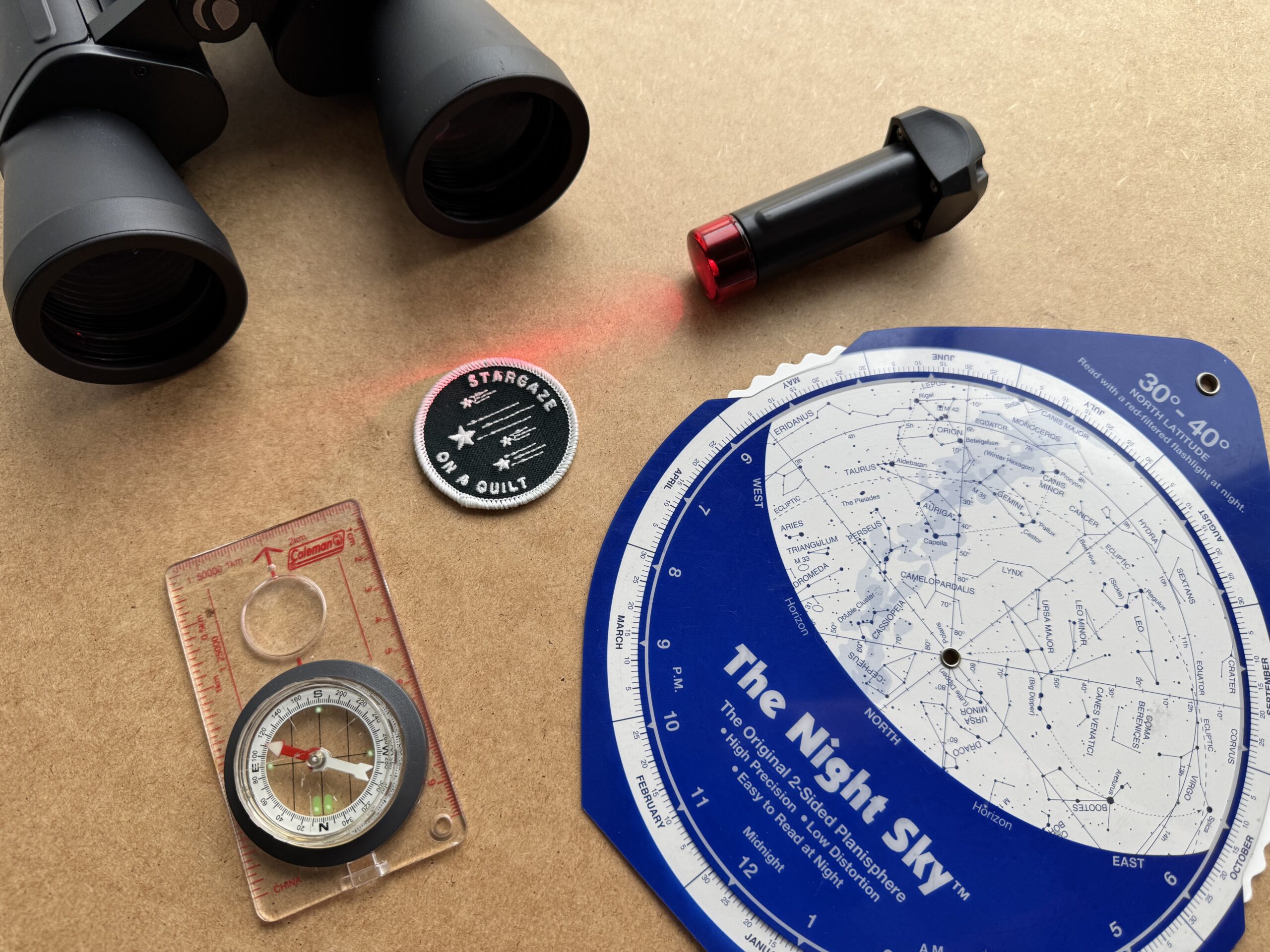
You don’t need a telescope. You don’t need fancy gear. You don’t need to drive hours into the wilderness on your very first try. If the sky is clear, step outside and look up. Even in a city, you may still see the moon, a few stars, or maybe even a planet.
And from there, get curious.
What are you looking at? Is it a star? A planet? A satellite? The International Space Station? Is it something that’s visible year-round or only seasonally?
That curiosity is really the spark.
If you want help figuring out what you’re seeing, Sarah recommended using an app like Star Guide. You can point it at the sky and it will tell you what’s above you. It’s one of those tools that makes stargazing feel instantly more approachable, especially for beginners.
I love anything that lowers the barrier to entry for a new hobby or adventure, and this definitely does that.
You Don’t Have to Travel Far to See Darker Skies
If you do want to level up your stargazing experience, Dark Sky International has an interactive map on their website where you can search for International Dark Sky Places around the world.
These are designated places with exceptional or distinguished quality night skies, and they can be amazing destinations for camping trips, road trips, or intentional little adventures built around the stars.
If seeing the Milky Way is on your bucket list, this is a great place to start.
But one thing I really appreciated in our conversation is that Sarah kept bringing the focus back to accessibility. Yes, dark sky travel is amazing. But the goal isn’t only to send people somewhere else to see the stars.
The bigger goal is to help more people see them from their own backyards.
And honestly? I love that.
Because while a dreamy dark-sky camping trip sounds incredible, there’s something especially meaningful about protecting wonder close to home.
How to Advocate for Darker Skies in Your Own Neighborhood
This part of the conversation made me laugh because it is so real: one of the hardest parts of neighborhood-level advocacy might just be talking to your neighbors.
Not writing a letter. Not reading a resource guide. Not downloading a flyer.
Just… knocking on the door and saying, “Hey, would you maybe mind turning off that very bright porch light for a bit?”
Truly terrifying. Very sweaty. Deeply humbling.
But Sarah had such a thoughtful approach to this. Instead of framing it as a complaint, she suggested inviting neighbors into the experience.
Something like: the stars are really bright tonight, want to come sit outside and enjoy them with us?
That shift feels so Quilt Scouts to me. Less confrontation, more campfire energy.
You could even make it a whole neighborhood event. A new moon stargazing night. A simple flyer. A “turn off your unnecessary outdoor lights and come look up” invitation. Cozy, communal, and a little bit magical.
Dark Sky International even has downloadable flyers and guides for how to talk to neighbors and advocate in your community, which makes this feel much more doable.
Why Darkness Is an Environmental Issue We Can Actually Solve
One of the most encouraging things Sarah shared is that this is one of the most immediately solvable environmental challenges we face.
We don’t need to invent some brand new technology. We don’t have to wait fifty years for a breakthrough. In many cases, the solution is incredibly simple:
Turn off lights when they’re not needed.
Use better bulbs.
Aim light where it belongs.
Dim it.
Warm it up.
Control it.
That’s what makes this issue feel so empowering. The moment unnecessary light goes away, darkness returns. Instantly.
There’s something really hopeful about that.
What We’re Missing When We Can’t See the Stars
This might have been my favorite part of the whole episode.
Sarah talked about a moment in New England when she looked up and faintly saw the Milky Way. Not in some remote wilderness destination. Not on a huge trip. Just in a moment when the neighborhood happened to be darker than usual.
And it took her breath away.
She described that feeling of seeing the sky and realizing we are part of something vast — something that can make us feel both very small and very powerful all at once.
That’s what we’re missing when we lose access to darkness.
We’re missing wonder. We’re missing perspective. We’re missing that quiet, ancient connection humans have had to the stars forever.
Sarah also shared something that completely blew my mind: so much of human progress traces back to stargazing. Our earliest calendars were based on celestial movement. Navigation depended on the stars. Curiosity about the sky helped shape science itself. Even technologies we now take for granted, like cameras and medical imaging, can trace their origins back through optics and telescopes.
That is such a powerful reminder that looking up has always mattered.
Sarah’s Quilting Story Started with an Ohio Star
Naturally, I had to ask Sarah about quilting too, and I absolutely loved hearing that she comes from a multi-generational quilting family.
Both of her parents are quilters — and not just casual quilters, but blue-ribbon-winning quilters. Her father leans into hand quilting and antique quilt restoration, while her mother was a quilt shop owner for 30 years and loves original design.
Basically: quilting was in the air.
Sarah’s own quilting journey started with an eighth grade project, when her mom suggested she make a little quilt. She chose an Ohio Star, and that was it. Gateway quilt unlocked.
Honestly, a very strong origin story.
The “Spite Quilt” I Will Be Thinking About Forever
Another highlight: Sarah described a Mariner’s Compass quilt she made with her mom after someone once told her mother that reproduction fabrics and batiks should never be used together in the same quilt.
Which, respectfully, is an absolutely bonkers thing to tell a quiltmaker.
So naturally, her mother responded the best possible way: by designing a quilt where every section intentionally paired reproduction fabrics with batiks.
I loved this.
A spite quilt? Iconic behavior.
And honestly, a pretty perfect reminder that quilting is also about creative freedom. We do not need permission to make things the way we want to make them.
The Connection Between Quilting and the Night Sky
When I asked Sarah if she sees an overlap between quilting and protecting the night sky, her answer was so good. She said both require us to slow down and design with intention.
Yes. Exactly that.
A quilt doesn’t happen by accident. It asks for care, attention, planning, patience, and creativity. And in a very similar way, protecting darkness asks us to think more intentionally about how we design our world.
How much light do we really need?
Where should it go?
What happens when we overdo it?
What would it look like to leave more room for night?
That connection felt so natural to me. Quilting and stargazing both invite us to notice more. To be present. To make space for beauty. To let wonder take up a little more room.
A Quilting Adventure, 25 Years in the Making
Toward the end of the episode, Sarah shared what “quilting adventure” looks like for her right now, and I adored this answer because it was so real.
She has been working on a pineapple log cabin quilt for 25 years.
Twenty-five.
She started it in high school in the 1990s, and she still has all the strips, foundations, and supplies. So far she has completed eight blocks.
Honestly? That is both hilarious and deeply relatable.
But what I loved most was how she framed it. This project is something she returns to when she needs to clear her mind. She sews a few strips, works on it a little, and then puts it away again until the next time.
Not every quilt has to be fast. Not every creative project has to be optimized, monetized, or finished on a neat little schedule. Some adventures are long ones.
Very long ones.
Books and Resources Sarah Recommends
Sarah also shared a couple of books for anyone wanting to think more deeply about darkness, creativity, and the nighttime world.
One is Sleepless by Annabel Abbs-Streets, which explores the idea that creativity can come alive after dark. As soon as Sarah mentioned quilters waking up in the middle of the night with an idea and heading straight to the sewing machine, I knew exactly what she meant.
The second is Night Magic by Leigh Ann Henion, which expands the idea of nighttime wonder beyond stargazing and into the whole living world that wakes up after dark.
Both sound wildly inspiring.
Final Thoughts: Go Outside and Look Up
If there’s one thing I hope you take from this conversation, it’s this:
You do not need to be an expert to start paying attention to the night sky.
You can start with your own backyard. You can start tonight.
Step outside. Look up. Notice the moon. Find one bright star. Download an app. Ask a question. Turn off a porch light. Invite a neighbor to stargaze. Wrap up in a quilt and let yourself feel a little tiny and a little amazed.
Resources Mentioned in This Episode
- Dark Sky International website
- Dark Sky International resources page
- International Dark Sky Places interactive map
- Dark Sky chapter finder
- International Dark Sky Week resources
- Public Outreach Materials
- Sleepless by Annabel Abbs-Streets
- Night Magic by Leigh Ann Henion
- Dark Sky International on Instagram
Listen to the Full Episode
Want to hear the full conversation with Sarah Martin, including our rapid-fire round and her very relatable 25-year pineapple log cabin saga?
Then grab a quilt, step outside, and go look up.
If you want, I can also turn this into a more SEO-friendly version with a stronger title, intro, and subheads for your website format.





+ show Comments
- Hide Comments
add a comment